
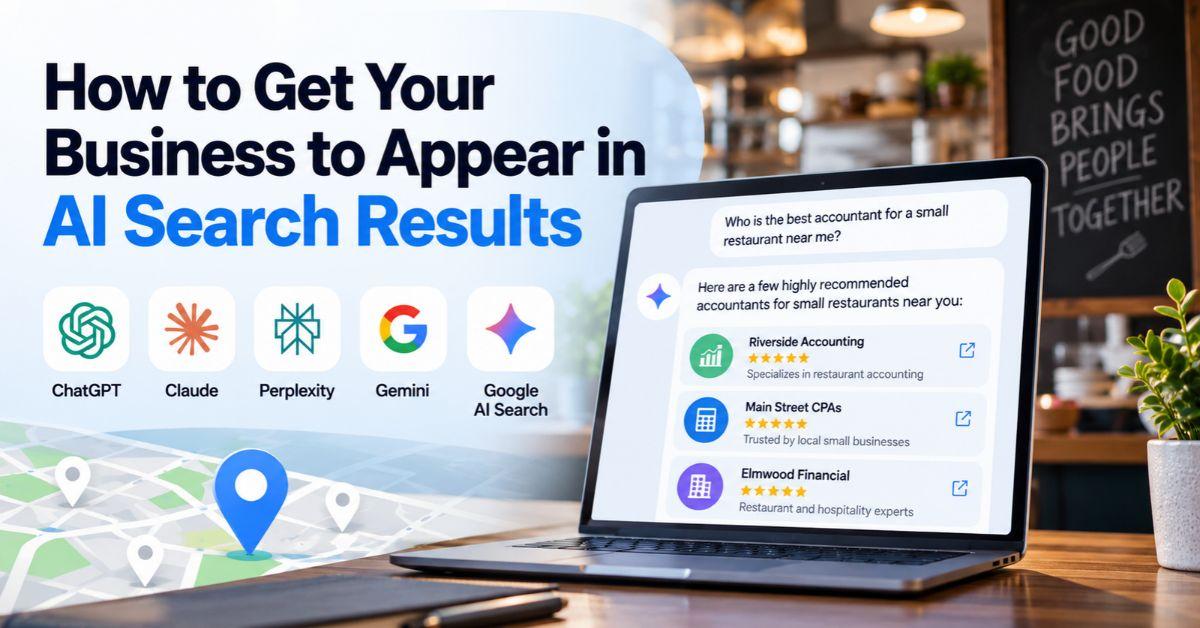
Picture a customer typing a question into either ChatGPT, Claude, Perplexity, or Google’s AI Search Mode: “Who is the best accountant for a small restaurant near me?” A short, confident answer appears, naming two or three businesses. Either your brand is in that answer, or it is not.
This is where generative engine optimization (GEO) comes in, helping position your business to be recommended by AI. GEO does not replace SEO, but builds on it. The brands that AI tools recommend tend to be the ones with clear, useful content, a consistent identity across the web, and credible mentions from other sources.
What is Generative Engine Optimization?
At its core, generative engine optimization (GEO) is the practice of improving how often and how favorably AI-powered search tools mention, recommend, and cite your brand in their answers. You may also hear it called AI search optimization or AI search visibility work. The names vary, but the goal is the same.
Two terms are worth knowing. AI search visibility is how often your brand appears in AI-generated answers for the questions your customers ask. The second is citation, which is when an AI answer names your brand or links to your page as a source.
Traditional search engine optimization (SEO) aims to rank a page in a list of search results for a search term so people click on the result. GEO aims to get your brand included in the AI answer itself, sometimes with a link and sometimes without one.
| Traditional SEO | GEO | |
|---|---|---|
| Goal | Rank pages in search results | Be mentioned and cited in AI answers |
| Where results appear | A list of links on a search results page for a search term | A written answer, often with sources for a question |
| What gets evaluated | Pages and links | Brands, facts, and passages across many external sources |
| Typical success metric | Rankings, clicks, organic traffic | Citations, mentions, AI referral traffic, branded search |
| Level of control | Moderate | Lower; influenced, not controlled |
How AI search tools choose which brands to mention
AI tools choose brands by combining what they learned in training with information they retrieve from the web at the moment of the question. Each tool does this a little differently, and the results change often. Here are a few common ones:
ChatGPT
When ChatGPT searches the web, it can show citations and a list of sources, and OpenAI says it sometimes works with third-party search providers. To be eligible to appear, a site needs to allow OpenAI’s search crawler, OAI-SearchBot. OpenAI also says placement is not guaranteed.3 Brands that are mentioned often and consistently across trusted sites are more likely to be cited.
Claude
Anthropic’s Claude can search the web when a question would benefit from current information. Anthropic says Claude grounds its responses in content from the live web and includes citations and source links, so readers can check where an answer came from.5 Without a search, Claude answers from what it learned in training, so well-established information about your brand can still shape what it says. As with the other tools, no one outside the company can promise how sources are chosen, which makes clear, current, trustworthy pages and consistent facts about your business the safest investment.
Gemini
Gemini is Google’s AI assistant. Google says that keeping Business Profile and Merchant Center details current can help local businesses and products show up in its generative AI responses.2
Perplexity
Perplexity retrieves sources in real time and shows them next to its answer.4 Pages that directly answer a question, are well organized, and come from credible sites are good candidates for citation.
Google Search AI Overviews and AI Mode
AI Overviews appear at the top of some Google results, and AI Mode offers a more conversational search experience. Both are built on Google Search. Google says there are no additional requirements or special optimizations beyond foundational SEO, and that a page must be indexed and eligible to appear in Search with a snippet to be shown as a supporting link. From Google’s perspective, optimizing for generative AI search is still SEO.2
What these tools have in common
Across most AI tools, the same signals keep showing up: clear answers to specific questions, content from sources that appear trustworthy, consistent facts about your brand across many places, and mentions from third parties such as reviews, press, and community discussions. That overlap is good news. You do not need four separate strategies.
Seven ways to improve your AI search visibility
Here are a few ways to raise your odds and improve your regular SEO at the same time.1. Answer questions directly
Open each section of a page with a clear, short answer, then add detail. If a page about emergency plumbing begins with “We offer 24-hour emergency plumbing across the metro area, with an average arrival time of 45 minutes,” an AI tool can lift that sentence cleanly. Similarly, an auto repair shop could start a brake repair section with, “We provide same-day brake repair for most vehicles, including brake pad and rotor replacement.” The clearer and more direct the answer, the easier it is for AI tools to understand and use. A page that circles the point for three paragraphs is harder to quote. You do not need to chop content into tiny pieces or rewrite it for machines, and Google says neither is required.2 Write for people, and put the answer first.2. Make your brand easy to identify
Use the same business name, description, address, services, and key facts everywhere: your website, Google Business Profile, location-specific pages, directories, and social profiles. Conflicting details make it harder for AI tools to be confident about who you are and what you do.
3. Earn mentions from other sources
AI tools can reflect what others say about you across the web. Reviews, local press, industry roundups, partner pages, and genuine participation in communities such as Reddit all count. Ask happy customers for detailed reviews, pitch useful commentary to publications in your field, and keep your profiles on relevant directories complete. Keep it authentic: Google says seeking inauthentic mentions is not as helpful as it might seem.24. Publish something only you can say
Google advises creating non-commodity content: original, experience-based work rather than a recycle of what is already online.2 AI summaries are good at repeating what is already common knowledge. They cannot easily replace original data, real-world case studies, or an expert’s firsthand view. A short survey of your customers, a documented before-and-after result, or a specialist’s honest take gives AI tools and people a reason to cite you.
5. Use structured data where it fits
Schema markup is code that labels the content on your page, such as your organization, products, reviews, FAQs, and local business details. Google says structured data is not required for its AI features and that no special schema is needed.1 2 However, it is still worth using as part of normal SEO because it can make pages eligible for rich results, and the markup must match the visible text on the page.1 Organization and LocalBusiness are sensible starting points.
6. Keep the technical door open
Technical accessibility also plays a vital role in AI search visibility. Make sure AI tools can access, crawl, and understand your content by focusing on:- Check robots.txt: Make sure your robots.txt file is not accidentally blocking crawlers used by AI search tools.
- Review hosting and security settings: Make sure firewalls, security plugins, or other settings are not preventing AI crawlers from accessing your pages.
- Consider llms.txt: If your site uses an llms.txt file, make sure it is properly configured and includes links to your most important content. Support varies across AI tools, but it can provide a structured way to highlight key information about your website.
- Improve page speed: Make sure important pages load quickly, particularly on mobile devices.
- Limit reliance on heavy scripts: Ensure the main content of your pages is accessible without requiring extensive JavaScript or other scripts to load.
- Make content easy to understand: If AI crawlers cannot access or understand your content, your pages are less likely to be discovered, referenced, or cited in AI-generated answers.
7. Keep key pages fresh
Out-of-date information is a risk for you and for AI tools. Review your most important pages every quarter, update prices, hours, statistics, and examples, and show a visible “last updated” date.How to measure whether you show up in AI answers
Measuring GEO performance is still evolving. AI-generated answers can vary depending on the user and context, so it helps to combine several data points to build a more complete picture of your brand’s visibility and performance across AI search tools.- Run a prompt audit. List 10 to 20 questions a customer might ask, such as “best [your service] for [your type of customer]” or “[your category] near me.” Ask each one in ChatGPT, Claude, Gemini, Perplexity, and Google AI Search Mode. Record whether your brand is named, whether it is linked, and which competitors appear.
- Check referral traffic. Use Google Analytics 4 or other analytics and GEO monitoring tools to track visits and referrals from AI platforms such as ChatGPT and Perplexity. Since some AI visits may not have clear attribution, monitor trends over time rather than relying on total referral traffic alone.
- Monitor branded search trends. An increase in searches for your business name may indicate growing brand awareness following mentions in AI-generated answers, even when those mentions do not result in direct website visits.
Frequently Asked Questions
What is the difference between SEO and GEO?
SEO aims to rank your pages in search results so people click through. GEO aims to get your brand mentioned and cited inside AI-generated answers. They share the same foundation of useful content, technical health, and credibility, so most GEO work also improves SEO.
Can I guarantee my business appears in AI search?
No. AI answers vary by person, question, and moment, and no company controls them. You can improve your chances with clear content, consistent brand information, structured data, and mentions from trusted third parties, but anyone promising a guaranteed placement is overstating what is possible.
Is SEO still worth investing in?
Yes. AI tools that search the web rely on content that is crawlable, indexed, and trustworthy, which is what SEO builds. Treat SEO as the base layer and GEO as the next layer on top of it.
How do I know if my brand appears in AI answers?
Run a prompt audit. Ask 10 to 20 questions your customers might ask across AI search tools such as ChatGPT, Claude, Gemini, Perplexity, and Google AI Search Mode. Record whether your brand is mentioned, recommended, or linked in the responses. Repeat the audit periodically and track AI referral traffic using Google Analytics 4 or another traffic monitoring tool.
What should a small business do first?
Start with your basics: make your business details consistent everywhere, complete your Google Business Profile, and add a direct answer to the top of your most important pages. Then collect detailed customer reviews and add structured data.
Make sure your brand is part of the answer
AI search is changing how customers find businesses, but the fundamentals remain the same: be clear, be credible, and be easy to find. Businesses that focus on these fundamentals today can build stronger visibility across AI search and be better positioned as new AI tools and search experiences continue to evolve.
If you are not sure where your brand stands, we can show you. Book a free AI visibility audit with Gray Coyote Digital. We will check how your business appears across AI search results, show you where competitors are being recommended instead, and outline the first steps to close the gap.
